


How should the wiring sequence of the OBD cable female connector harness be arranged according to standards to avoid connection errors?
Release Time : 2026-02-26
The wiring sequence of the OBD cable female connector harness is crucial for ensuring stable communication between the automotive diagnostic system and external devices. Its design must strictly adhere to international standards such as SAE J1962, systematically avoiding connection errors through standardized pin definitions, functional grouping layouts, error-proofing structural design, physical isolation protection, optimized labeling systems, compatibility verification, and user training.
This standardized definition ensures consistency between the physical and protocol layers of the OBD interface across different vehicle models, providing a fundamental framework for harness design. The wiring sequence of the female connector harness must strictly correspond to the pin functions in the standard. For example, placing the CAN high line (pin 6) and the CAN low line (pin 14) side-by-side reduces signal interference and improves communication stability.
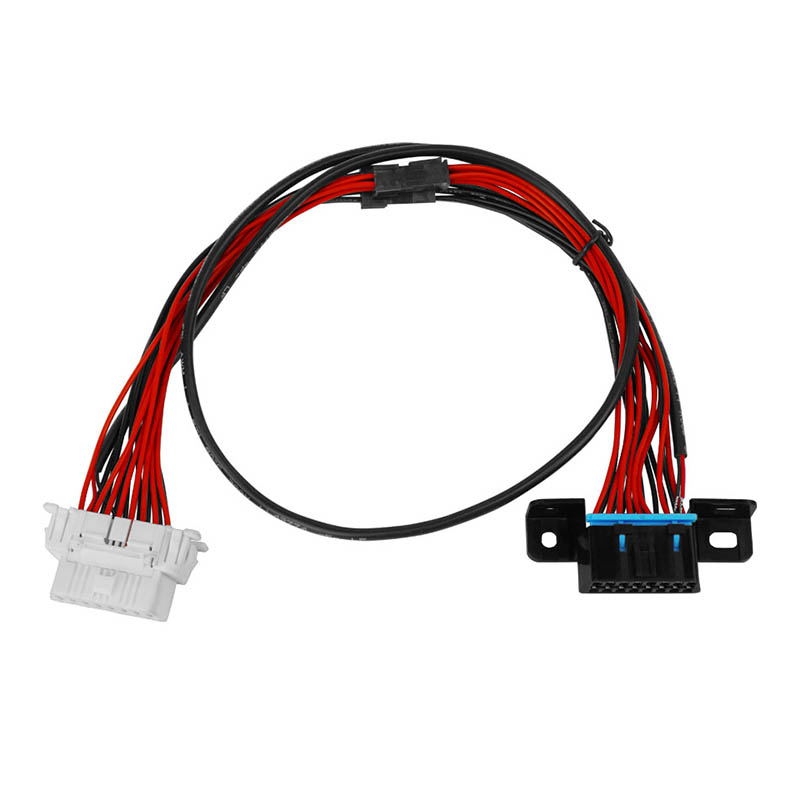
Regarding functional grouping layouts, the female connector harness typically arranges power lines (e.g., pin 16, always powered), ground lines (pins 4 and 5), communication lines (pins 6 and 14 for the CAN bus, pins 7 and 15 for K/L lines), and reserved pins in separate zones. This layout allows maintenance personnel to quickly identify critical wiring sequences when connecting equipment, such as distinguishing power lines (red) and ground lines (black) by color, or differentiating high-frequency communication lines from low-frequency control lines by differences in wire harness length. Functional grouping also reduces the risk of short circuits caused by incorrect wiring sequences, for example, by avoiding cross-connection of constant power and signal ground.
Error-proofing design is a core means of preventing connection errors. OBD cable female connectors often employ asymmetrical designs, such as adjusting the shape, size, or position of the male and female terminals to ensure the harness can only be inserted into the OBD interface in the correct orientation. Some designs also add guide slots or positioning posts to the connector housing to match the corresponding structure of the OBD interface, preventing reverse insertion. For example, in one vehicle model, the OBD female connector for the 6th pin is designed with a trapezoidal cross-section, while the corresponding pin of the interface has a rectangular slot, allowing full insertion only when the harness is oriented correctly.
Physical isolation protection further enhances wiring reliability. Communication lines (such as CAN bus) in female connector harnesses typically use twisted-pair structures and are wrapped with a shielding layer to reduce electromagnetic interference. Insulation strips or increased wiring harness spacing are used between power lines and signal lines to prevent high-voltage pulses from affecting low-level signals. For example, one wiring harness design places the 16th pin, a constant wire, away from the CAN bus and reduces the risk of short circuits by increasing the insulation thickness.
Identification system optimization is a key measure to assist in wiring sequence identification. The outer sheath of the female connector wiring harness is printed with pin numbers and function identifiers, such as "CAN H (6)" and "CAN L (14)", to facilitate quick verification by maintenance personnel. Some designs also mark the vehicle brand or model information on the connector surface to avoid misuse across different models. For example, a universal OBD female connector wiring harness adds a QR code label to the connector; scanning it provides the wiring sequence definition and a list of compatible models.
Compatibility verification is the final step in ensuring wiring sequence standardization. Before mass production, female connector wiring harnesses must undergo laboratory testing to verify their physical compatibility (such as insertion and extraction force, contact resistance) and electrical compatibility (such as CAN bus communication rate, K-line protocol support) with OBD interfaces of different models. For example, a wiring harness manufacturer might use a test fixture simulating the OBD interface to perform thousands of plug-in/plug-out cycles on the wiring harness to ensure stable connectivity even after long-term use.
User training and operating procedures are the last line of defense against connection errors. Automotive repair manuals clearly indicate the location of the OBD interface and the wiring harness connection steps, such as requiring operation with the vehicle off and avoiding hot-plugging. Some diagnostic devices also include a wiring sequence verification function in their software interface, automatically alarming and prompting for correct operation when an abnormal connection is detected. For example, one OBD diagnostic tool, after connecting the wiring harness, will first check if the voltage at pin 16 is 12V; if the voltage is abnormal, it will block subsequent communication to prevent device damage.