


How does an OBD connection cable unlock the door to intelligent automotive diagnostics with a universal interface?
Release Time : 2026-01-30
In today's increasingly intelligent automotive world, every vehicle on the road is like a sophisticated mobile computer system, riddled with sensors, control units, and data networks. To understand the language of this "steel brain" and obtain its operating status, fault information, or performance parameters, the OBD connection cable becomes an indispensable bridge. This 16-pin OBD2 cable, designed specifically for professional users and automotive enthusiasts, transforms the complex on-board diagnostic system into an intuitive and readable information flow thanks to its standardized interface, high compatibility, and reliable signal transmission capabilities, allowing vehicle maintenance to move from experience-based judgment to data-driven approaches.
OBD (On-Board Diagnostics) systems have gradually become widespread since the late 20th century and are now a mandatory standard in global automotive manufacturing. They uniformly use a 16-pin D-type interface, typically located under the driver's compartment for easy access. The core function of the OBD connection cable is to securely and reliably extend this hidden data port within the vehicle to external devices—whether it's a handheld scanner, tablet, or professional diagnostic tool. This cable allows technicians or vehicle owners to read hundreds of parameters in real time, including engine speed, coolant temperature, fuel system status, emissions data, and even transmission operating mode.
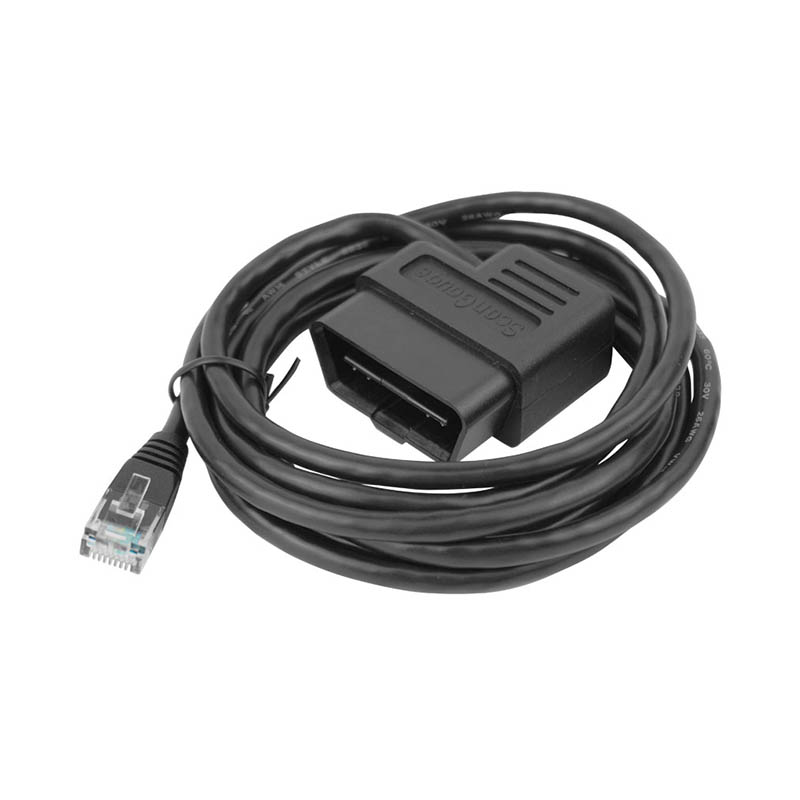
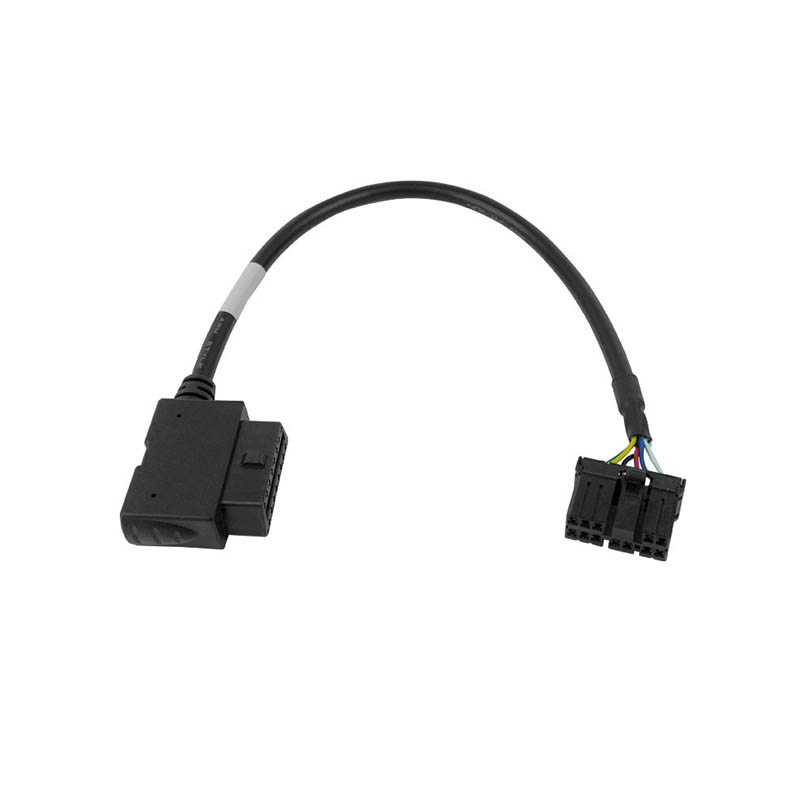
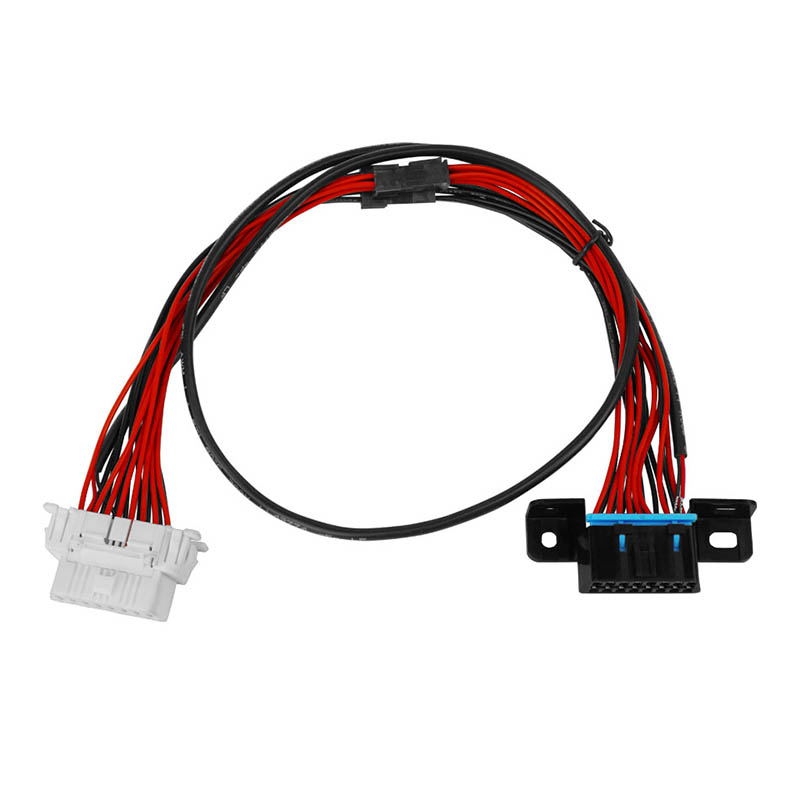
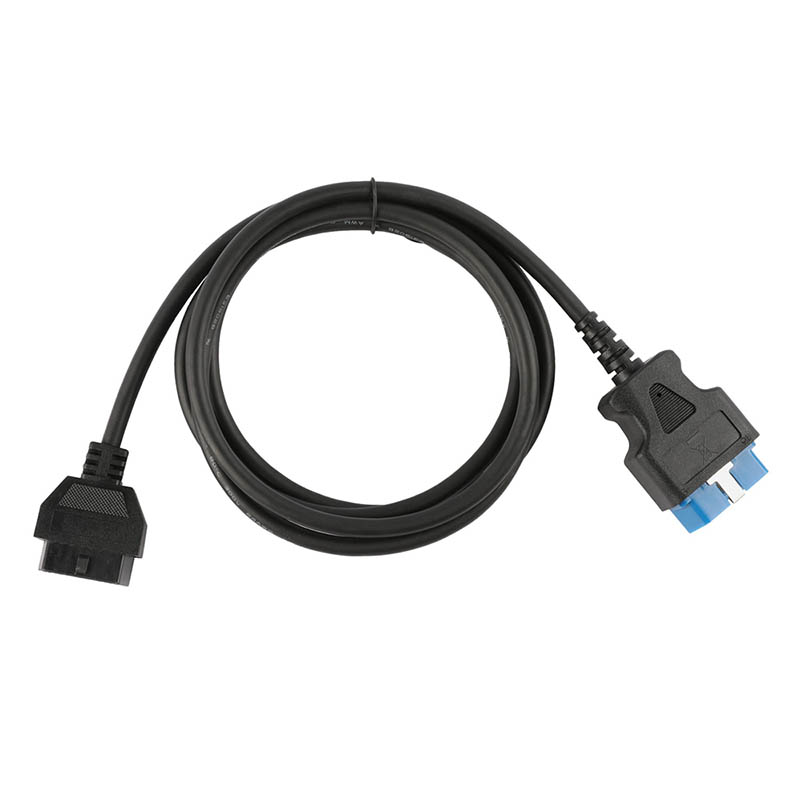
The cable's design prioritizes practicality and durability. The outer layer is wrapped in high-toughness PVC or braided nylon, making it tensile-resistant, oil-resistant, and tangle-free. Even repeated bending in the confined space of an engine compartment will not easily damage it. The internal wiring is arranged according to original equipment manufacturer (OEM) specifications, and the shielding layer effectively suppresses electromagnetic interference, ensuring undistorted high-speed CAN bus signal transmission. The connector precisely matches the OBD2 female connector, ensuring smooth insertion and removal with a secure connection, preventing communication interruptions due to loosening. Some high-end models also integrate LED indicator lights to clearly display power and communication status, enhancing the user experience.
Compatibility is its greatest advantage. Adhering to the internationally unified OBD2 protocol, this cable is compatible with almost all gasoline vehicles manufactured after 1996 and diesel vehicles manufactured after 2004, covering mainstream brands from Europe, America, Japan, South Korea, and China. Whether used for clearing fault codes, monitoring real-time fuel consumption, recording driving data, or optimizing performance with tuning software, a single cable can be used for multiple scenarios, eliminating the need for specialized tools for different vehicle models. This "one-cable-for-all" characteristic significantly lowers the barrier to entry for repairs and reduces equipment costs.
In professional fields, the OBD connection cable is crucial for efficient operations. Quick-service technicians use it to quickly locate fault sources, avoiding blind disassembly and inspection; fleet managers use it to batch read vehicle health reports for preventative maintenance; and automotive engineers use the high-bandwidth cable to collect raw data for research and development verification. For ordinary users, it also proves valuable: when a fault light illuminates on the dashboard, connecting to a mobile app allows for a preliminary assessment of the problem's severity, preventing over-repair; before long-distance travel, it can also check the status of the emissions and ignition systems to ensure driving safety.
A deeper significance lies in its promotion of transparency and democratization in the automotive aftermarket service. Vehicle data previously only accessible to 4S dealerships is now open to the public through the open OBD interface. Consumers can truly "see" the internal condition of their vehicles and make more informed maintenance decisions. This information equality not only enhances user experience but also forces the service industry to improve its professional standards.
Although the OBD connection cable has a simple structure, it bears the heavy responsibility of facilitating communication between humans and machines. It doesn't generate power, yet it reveals the secrets of the power system; it doesn't fix faults, yet it points the way to repair them. Within this seemingly ordinary cable flows not only current and data, but also the modern concepts of trust in technology, autonomous control, and rational consumption. Every "click" when plugged into the OBD interface is a key to unlocking the intelligent world of automobiles—silent, yet full of possibilities.
OBD (On-Board Diagnostics) systems have gradually become widespread since the late 20th century and are now a mandatory standard in global automotive manufacturing. They uniformly use a 16-pin D-type interface, typically located under the driver's compartment for easy access. The core function of the OBD connection cable is to securely and reliably extend this hidden data port within the vehicle to external devices—whether it's a handheld scanner, tablet, or professional diagnostic tool. This cable allows technicians or vehicle owners to read hundreds of parameters in real time, including engine speed, coolant temperature, fuel system status, emissions data, and even transmission operating mode.
The cable's design prioritizes practicality and durability. The outer layer is wrapped in high-toughness PVC or braided nylon, making it tensile-resistant, oil-resistant, and tangle-free. Even repeated bending in the confined space of an engine compartment will not easily damage it. The internal wiring is arranged according to original equipment manufacturer (OEM) specifications, and the shielding layer effectively suppresses electromagnetic interference, ensuring undistorted high-speed CAN bus signal transmission. The connector precisely matches the OBD2 female connector, ensuring smooth insertion and removal with a secure connection, preventing communication interruptions due to loosening. Some high-end models also integrate LED indicator lights to clearly display power and communication status, enhancing the user experience.
Compatibility is its greatest advantage. Adhering to the internationally unified OBD2 protocol, this cable is compatible with almost all gasoline vehicles manufactured after 1996 and diesel vehicles manufactured after 2004, covering mainstream brands from Europe, America, Japan, South Korea, and China. Whether used for clearing fault codes, monitoring real-time fuel consumption, recording driving data, or optimizing performance with tuning software, a single cable can be used for multiple scenarios, eliminating the need for specialized tools for different vehicle models. This "one-cable-for-all" characteristic significantly lowers the barrier to entry for repairs and reduces equipment costs.
In professional fields, the OBD connection cable is crucial for efficient operations. Quick-service technicians use it to quickly locate fault sources, avoiding blind disassembly and inspection; fleet managers use it to batch read vehicle health reports for preventative maintenance; and automotive engineers use the high-bandwidth cable to collect raw data for research and development verification. For ordinary users, it also proves valuable: when a fault light illuminates on the dashboard, connecting to a mobile app allows for a preliminary assessment of the problem's severity, preventing over-repair; before long-distance travel, it can also check the status of the emissions and ignition systems to ensure driving safety.
A deeper significance lies in its promotion of transparency and democratization in the automotive aftermarket service. Vehicle data previously only accessible to 4S dealerships is now open to the public through the open OBD interface. Consumers can truly "see" the internal condition of their vehicles and make more informed maintenance decisions. This information equality not only enhances user experience but also forces the service industry to improve its professional standards.
Although the OBD connection cable has a simple structure, it bears the heavy responsibility of facilitating communication between humans and machines. It doesn't generate power, yet it reveals the secrets of the power system; it doesn't fix faults, yet it points the way to repair them. Within this seemingly ordinary cable flows not only current and data, but also the modern concepts of trust in technology, autonomous control, and rational consumption. Every "click" when plugged into the OBD interface is a key to unlocking the intelligent world of automobiles—silent, yet full of possibilities.